
82% ROI on the World Cup Heading Into Day Four!
Day Four at the World Cup: a 27-point gap on Ivory Coast vs Ecuador, the new rule behind our 8-1 run, and why a longshot just paid for our worst day.

Three days in, and yesterday taught me more about this project than the two good days before it. We had a forecast blow up in our faces, the Switzerland one, and we had a longshot we backed against the grain come in and pay for the entire day by itself. Both of those things are the job. So today we are doing something I have wanted to do for a while: tightening what we actually publish, and showing you exactly why. From now on we lead with one number and one rule, and I will explain it below. But first, for the people who came for the plays and not the philosophy, here is the card.
Today’s key picks, if you’re in a hurry
These are the only plays that clear our new bar, biggest edge first:
Ivory Coast vs Ecuador: Under 2.5 goals. Our biggest edge of the entire tournament so far, 27 points clear of the market.
Ivory Coast to win. The bold one. The market likes Ecuador, our model likes Ivory Coast, and we are siding with the model.
Ivory Coast vs Ecuador: both teams to score, No.
Sweden to win. A genuine edge, but it lands in the one zone our model has been too confident in, so this one rides at half stake.
Netherlands vs Japan: Under 2.5 goals.
Germany vs Curaçao: Over 2.5 goals. Short price, but the model wants the goals.
If that is all you came for, enjoy the football. If you want to know why these and not the dozen other markets, keep reading, because the why changed yesterday.
The new rule: we only publish ten-point edges
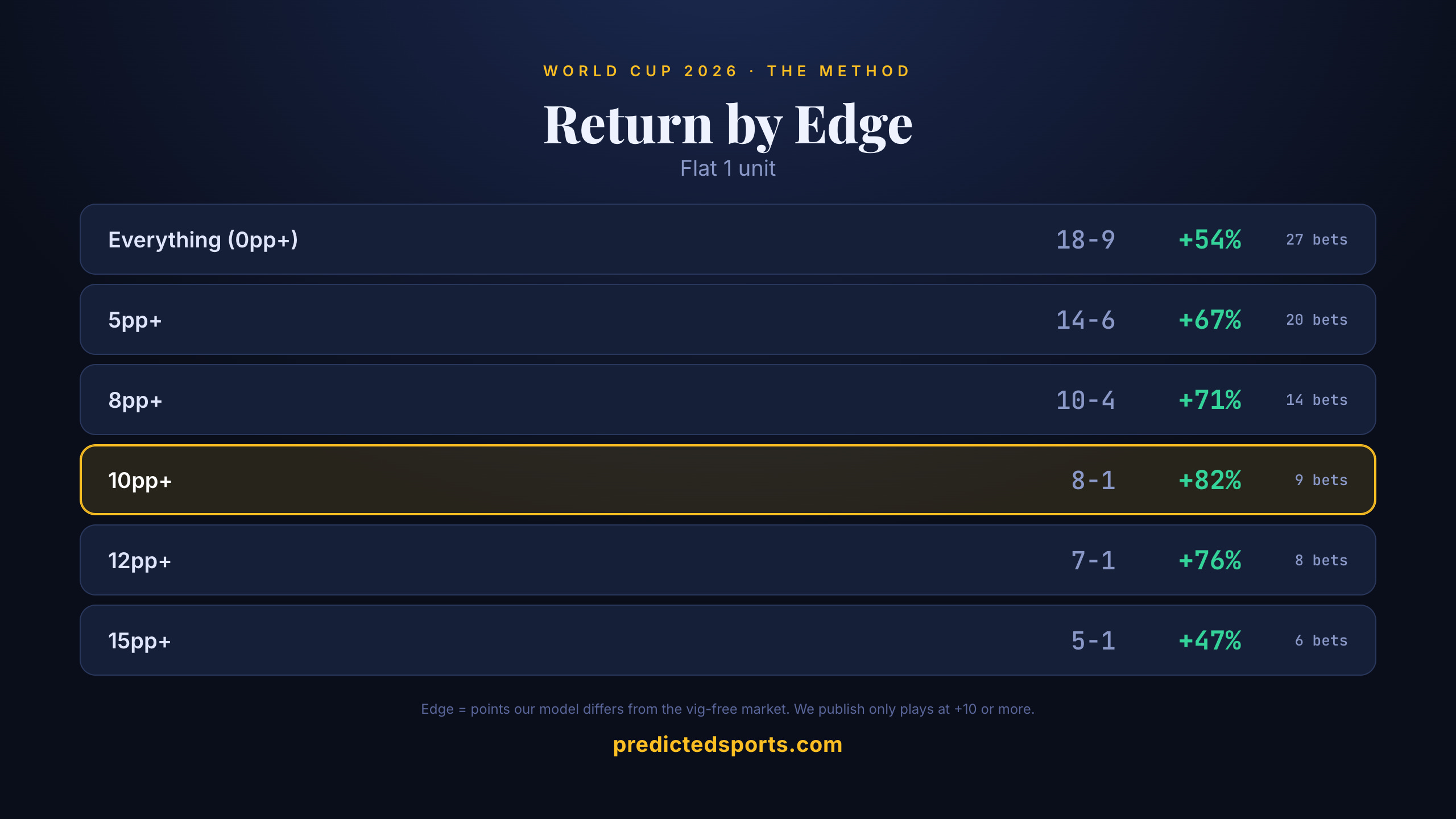
Here is the honest problem with how we have been doing it. We were posting our read on every market on every game, and that blends two different things into one blurry record. So I went back and graded every bet we have made by the size of its edge, the gap between our price and the market’s. The pattern was loud enough that I am now building the whole product around it.
When you sort our bets by edge and raise the floor, the return climbs and then peaks right around a ten-point edge:
Everything we have flagged: 18 and 9, plus 54 percent.
Edges of 5 points or more: 14 and 6, plus 67 percent.
Edges of 8 points or more: 10 and 4, plus 71 percent.
Edges of 10 points or more: 8 and 1, plus 82 percent.
Edges of 12 or more: 7 and 1, plus 76 percent.
Edges of 15 or more: 5 and 1, but a thinner sample.
Ten points is the sweet spot, and it is not a coincidence. A heavy favorite at a short price can only ever produce a thin edge in points, so a ten-point floor naturally screens out the chalky moneylines and pushes the card toward totals and both-teams-to-score, which is exactly where our model has been sharp. The rule does the hard part for us. Going forward, the plays we publish, the ones we grade in public, are the ten-point edges. Everything else still appears on our cards as the full model run, but it does not count as a play.
One more piece of discipline. The one place a ten-point edge has not paid is the heavy favorite, because that is precisely where our model runs a little too hot. So those plays ride at half stake. You will see that today on Sweden.
This is the number to hold us to from here on out: ten-point edges, 8 and 1, plus 82 percent. Small sample, no closing-line proof yet, variance is patient, and I am not getting a tattoo. But it is the cleanest signal we have, and now it is the rule.
Yesterday: Australia paid the whole bill
I have to call this one out, because it is the perfect example of everything above. Australia were a value underdog at better than 5 to 1. We told you plainly they would probably lose and that we were backing them anyway because the price was too long. They won 2-0. That single bet returned more than four units on its own, and it turned a six and six betting day into a green one. It also wrecked Group D: Turkey lost as the favorite and watched their odds to advance collapse from 87 percent to about 52, while Australia shot up to nearly certain.
Now the honest footnote, because it matters for the new rule. Australia’s edge was just under our ten-point line, so under the methodology we are launching today, Australia is not a key pick. It lives in a smaller, clearly separate bucket of longshot value swings. The big winner came from the bucket we are deliberately keeping to the side, and that is fine. The point of the rule is not to catch every winner, it is to keep the published card disciplined and let the value dogs ride alongside it, labeled for what they are. I would rather miss a 5 to 1 winner than dilute the thing we are actually selling.
So where we stand: our forecasts are 16 and 8 on the calls, and the ten-point key picks are 8 and 1 at plus 82 percent. On to today.
Game one: Ivory Coast vs Ecuador, the loaded one
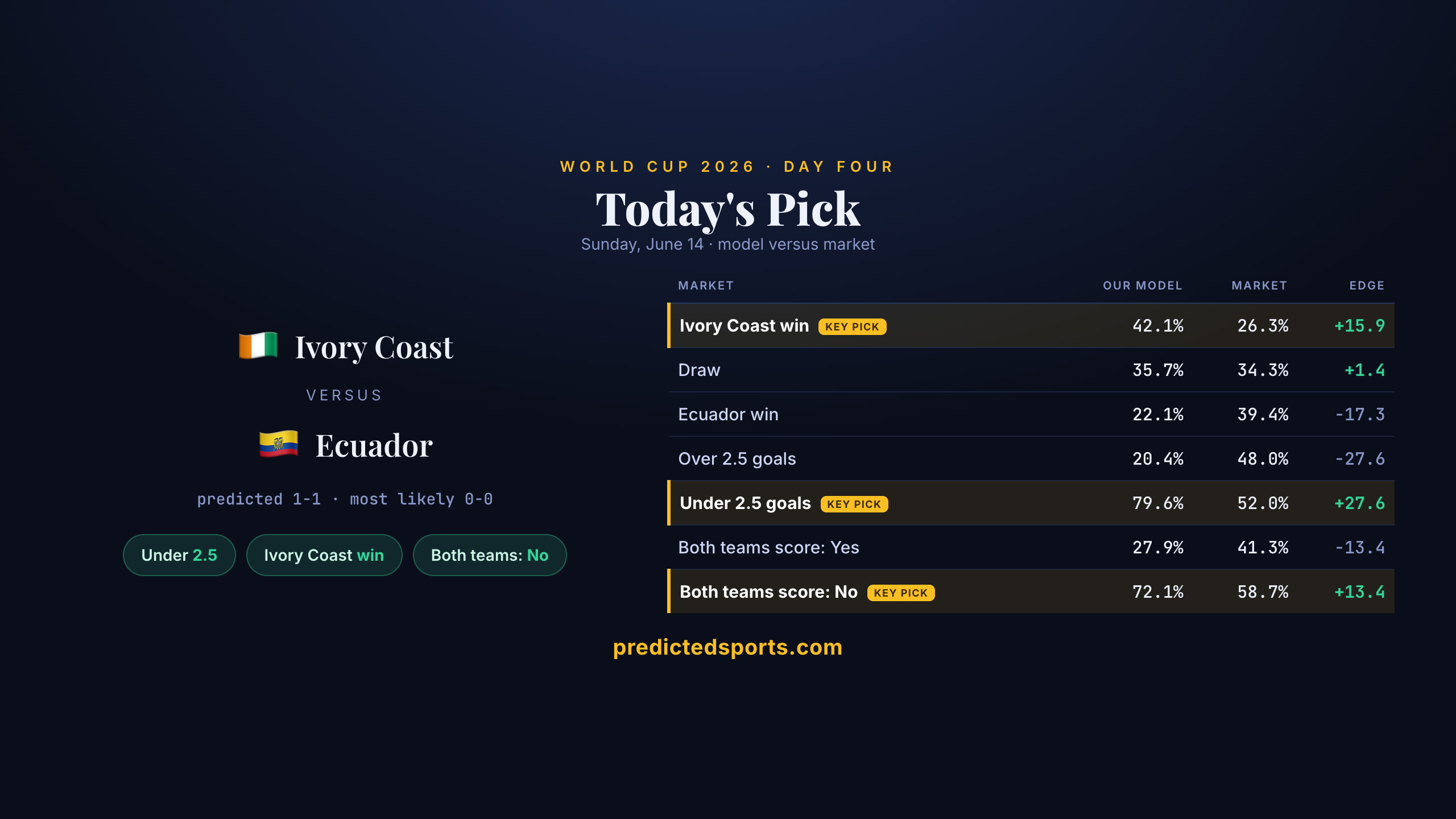
This is the most interesting game on our board all tournament, because we have three separate ten-point edges in one match, and one of them is a fight with the market.
Start with the goals, because it is the biggest edge we have posted yet. The model wants the Under 2.5 and it is not close, 80 percent for us against a market sitting around 52. These are two of the most organized, low-event defenses in the field, and the projected total is under two goals. Twenty-seven points of edge is the kind of gap that either means we see something real or we have a screw loose, and given how our unders have run, I trust it.
Then the winner. The market makes Ecuador the favorite on the back of that elite defense. Our model disagrees and makes Ivory Coast the side more likely to win, 42 percent to 26. That is a real disagreement, not a rounding error, and I want to be upfront that it is the boldest call we have made. When the market and the model point in opposite directions, one of us is wrong. We are taking the model. Alongside it, both teams to score, No, fits the same low-scoring picture and is a ten-point edge in its own right.
Game two: Netherlands vs Japan, the quiet under
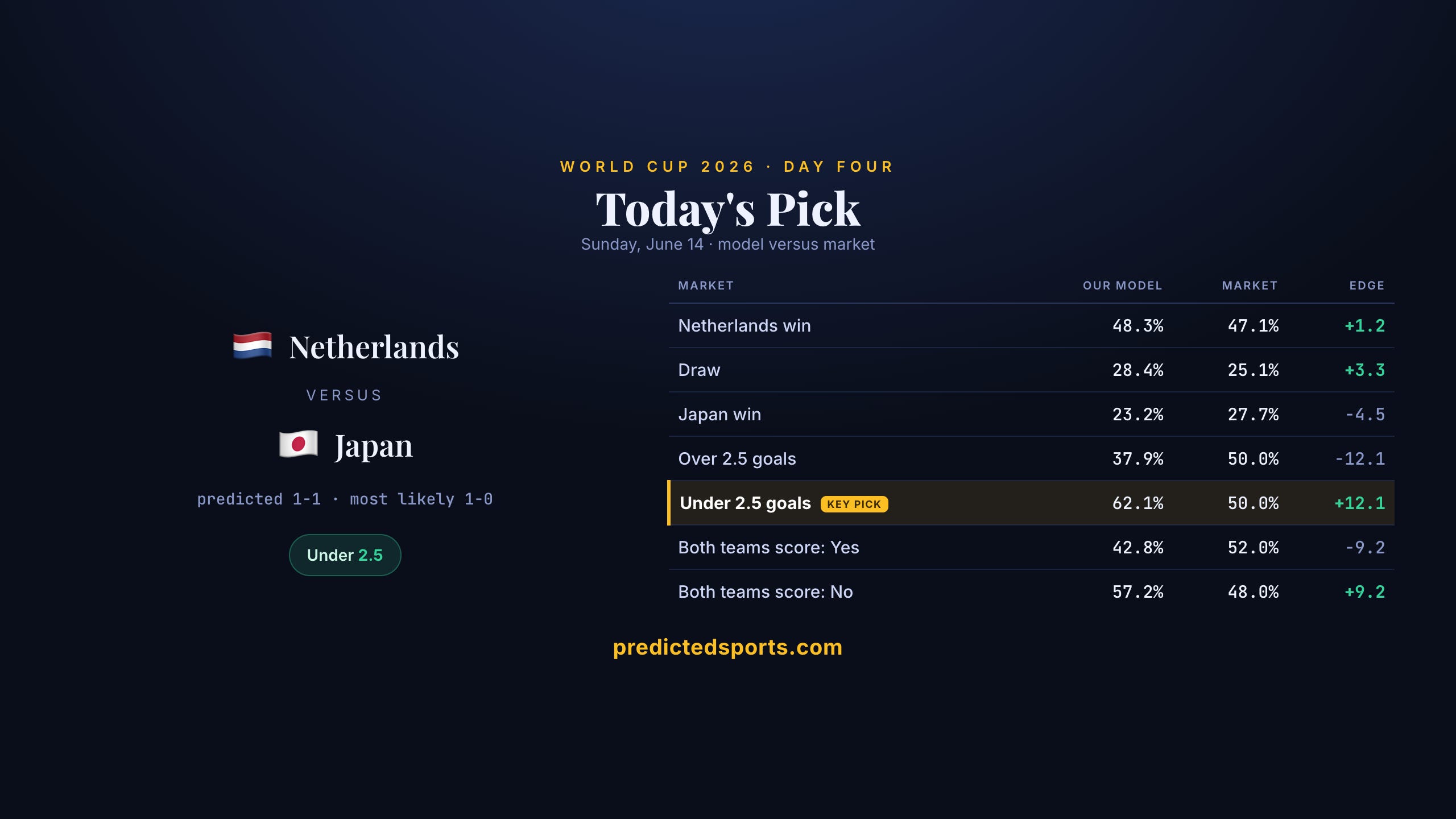
The winner market here is basically a coin flip and the model agrees, so there is no edge to chase on who wins. Japan are a serious, well-drilled side and the Dutch will have to earn it. The edge is in the goals. The market prices this as a wide-open, both-ends game at around even money for the over. The model sees it the other way, a tight, controlled 1 to nothing kind of night, and lands on the Under 2.5 at a 12-point edge. That is the only play we publish here, and it is a clean one.
Game three: Sweden vs Tunisia, the one we trust least
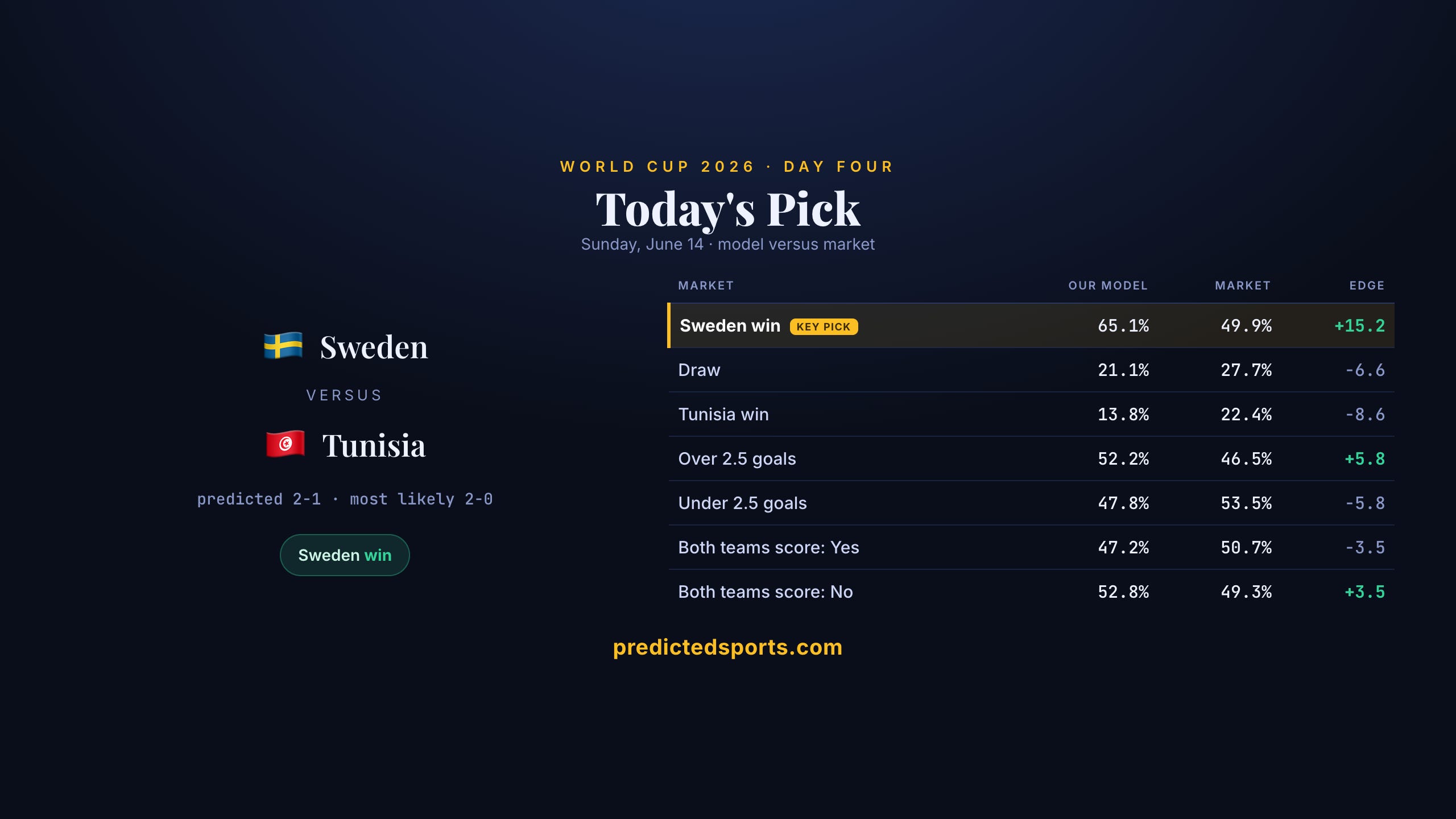
This is the teaching example for the new staking rule. The model loves Sweden, 65 percent to win against a market that has them at roughly 50. On paper that is a 15-point edge, one of the biggest on the card. But it is a heavy-favorite moneyline, and that is the exact zone where our model has been overconfident and where a fat edge has burned us before. So we publish it, because the rule says publish ten-point edges, but we back it at half stake. It is the difference between trusting the process and trusting it blindly. Sweden should have enough to win. We are just not betting the house on a number our model tends to inflate.
Game four: Germany vs Curaçao, the chalk
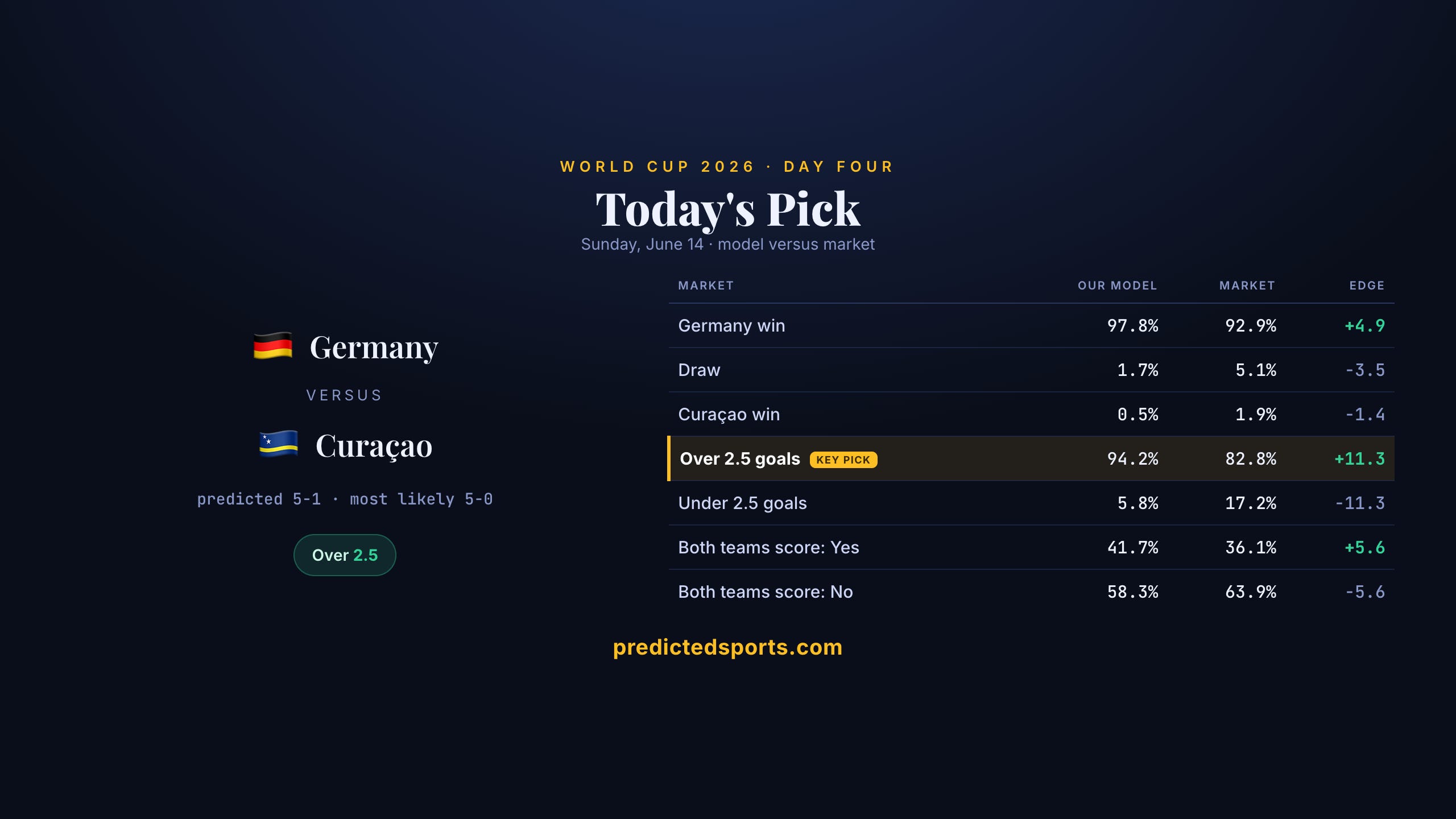
Not much mystery on the winner. Germany are a class apart and the model has them at nearly 98 percent, even higher than the short price the market is offering. There is no value in laying that. The one play is the Over 2.5 goals. Germany are projected to score around five, Curaçao have shipped goals in bunches lately, and even at a short price of around 1.14 the model still sees an 11-point edge. It is a small return for the risk, but it clears the bar, so onto the card it goes.
The card
A loaded Ivory Coast game with three edges including a fight with the market, two clean unders, a half-stake Sweden, and a chalky German over. Every price is logged, the ten-point plays are the ones that count, and by tomorrow we will know how it went with the receipts out. That is the whole idea: fewer plays, a clearer rule, and the same promise to show you the bad days as loudly as the good ones. Enjoy the football.